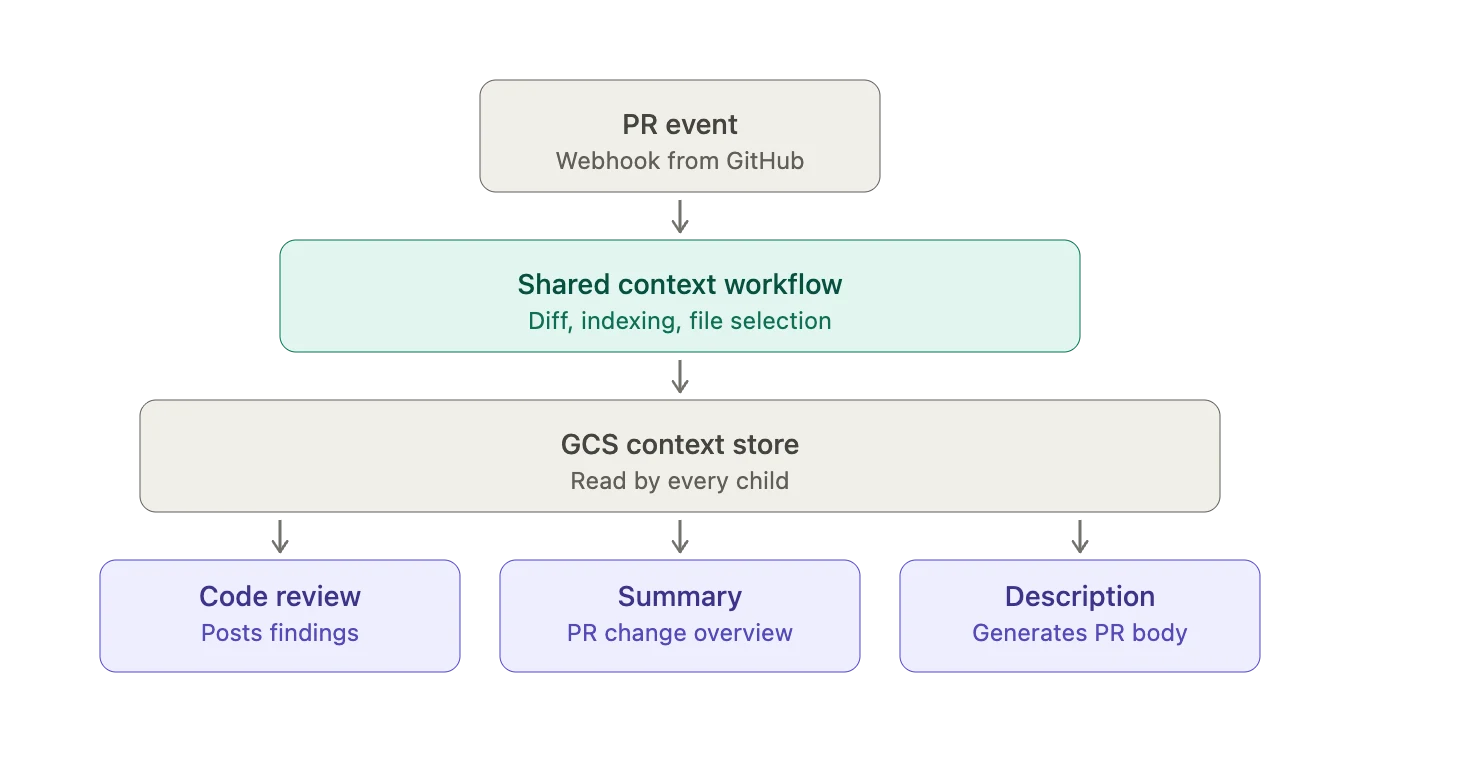
At its core, CodePal starts with the code diff like any other code reviewer but now it has deep symbolic context across the repository, and for a growing share of reviews, across repositories. It goes well beyond surface-level checks. Part 2 covers the cross-repo capability in depth.
For a growing portion of reviews, CodePal also reaches across repository boundaries via Code Search, an internal semantic search system covering Snap's full codebase. Before a function signature change merges, CodePal can identify the downstream callers that would break, even when they live in a different repo than the one the PR touches. This has already caught real cross-repo breakages before they merged, bugs no reviewer looking only at the diff could have flagged. Part 2 covers Code Search in depth, including how we integrated it into CodePal.
CodePal looks for issues that aren't typically caught by compilation or test suites: logic errors, null pointer risks, race conditions, resource leaks, error handling gaps, type mismatches, edge cases, and state management problems. For some repositories, it applies additional checks that are specific to that repo so that reviews can be tailored towards exactly what it needs.
Engineers consistently validate CodePal’s findings, and the majority of accepted bugs (bugs with a +1 vote in the PR review) found by CodePal rank as Critical or High severity. These are issues that, without CodePal, would have needed to have been caught by the human reviewer to ensure they don’t reach production. It has also allowed us to identify potential performance-related findings during development, prior to release.
Beyond line-by-line analysis, CodePal generates semantic diff summaries that explain what a PR does and why, giving reviewers a high-level understanding before they dive into the code. It can also auto-generate PR descriptions, titles, and structured sections like release notes or migration steps, all inferred directly from the code changes.
These features save significant time for both authors and reviewers. Instead of spending the first ten minutes of a review figuring out what a PR is doing, reviewers can jump straight to evaluating whether the approach is correct. These outputs, review findings, semantic summary, generated description, all flow from the same context build, which we'll cover below.